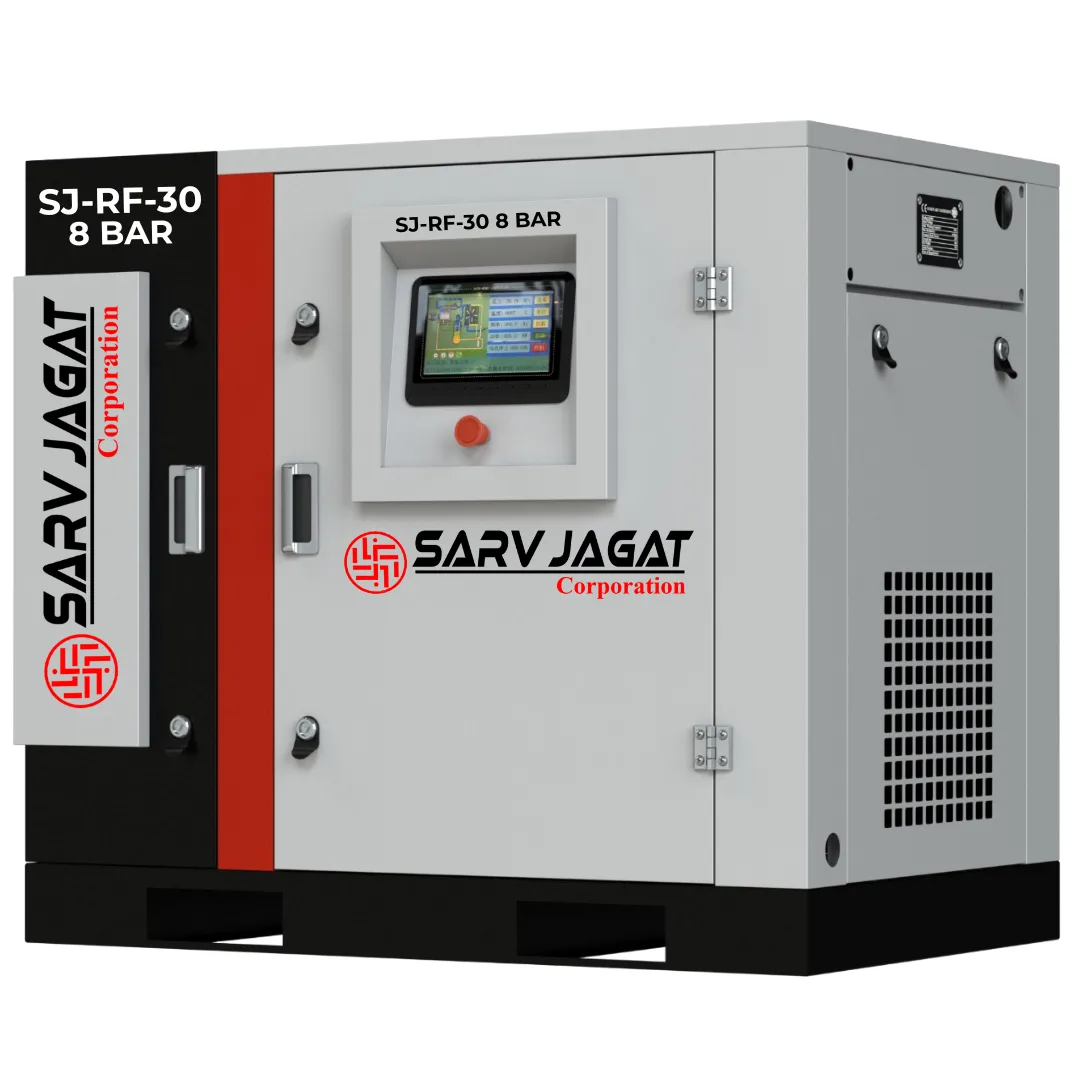
SJ RV 25⚡ Permanent Magnet VFD
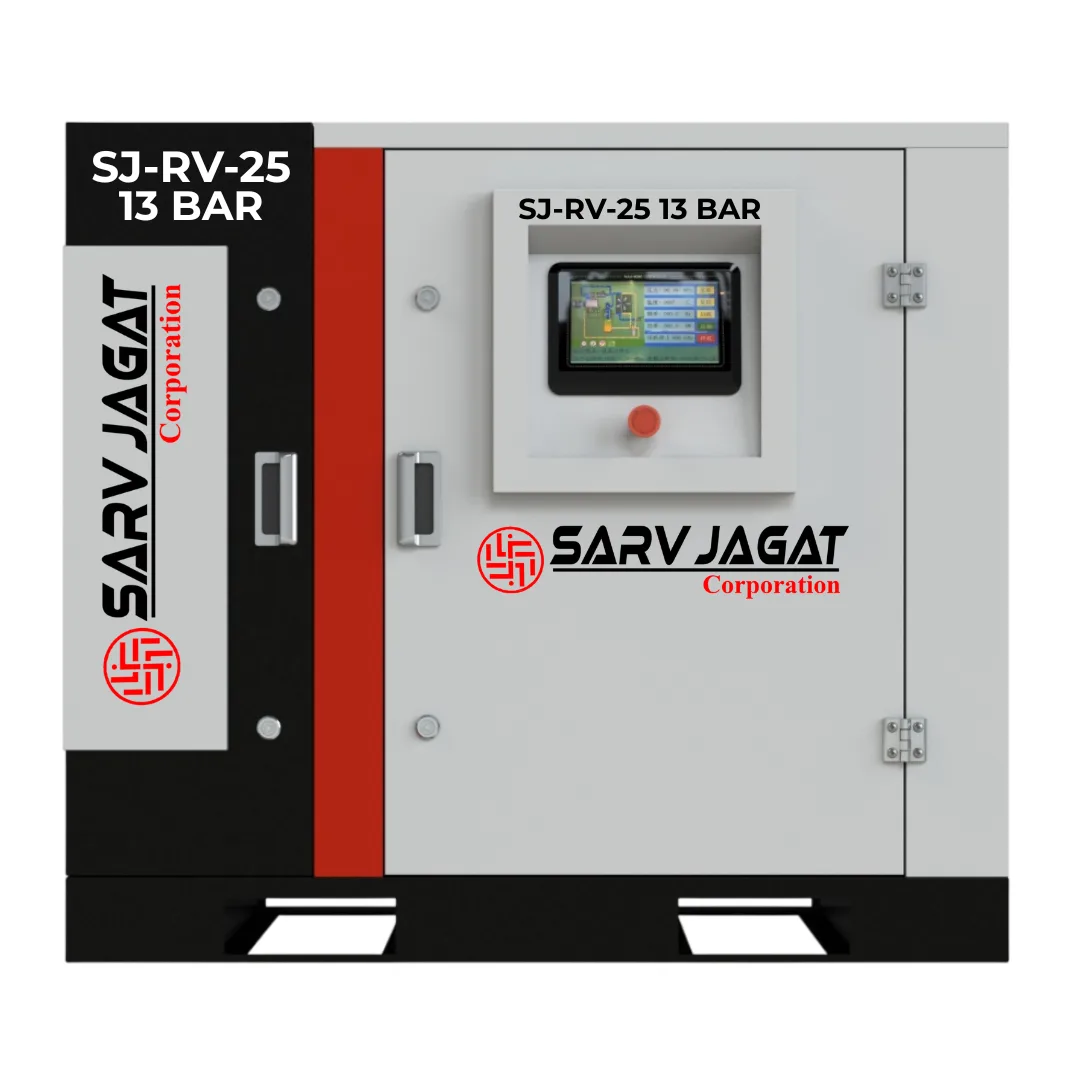
Power: 25 HPDual Voltage (50/60 Hz Global Ready)
✓ ISO 9001:2015 Certified
✓ CE Standard Design
✓ IS 5456 Performance Rating
High Pressure Variable Speed SJ Screw Air Compressor VFD/VSD•Model Code: SJ RV 25
25 HP 13 Bar SJ VFD Variable Speed Screw Air Compressor
The 25 HP VFD screw air compressor delivers 78 CFM at 13 bar. Variable-speed rotary screw technology for industrial compressed air solutions.
Motor Power25 HP18.5 kW Electrical
Working Pressure13 Bar190 PSI Rating
Free Air Delivery78 CFM2.21 m³/min
Factory Price (Ex-Works)₹4,10,000
GST & Export Documentation ReadyCore Engineering Highlights:
Permanent Magnet Synchronous Motor (IE4 super-premium efficiency rating)
Advanced vector inverter frequency control saving up to 35% on electrical costs
Precision asymmetric twin-screw rotor profile with SKF heavy-duty bearings
Smart MAM-880 micro-computer controller with pressure & temperature protection
Soft-start zero inrush current design extending motor and mechanical life
Factory Hotline: +91-9157487233Worldwide Sea-Worthy Packaging
Verified Technical Data Sheet
ENGINEERING SPECIFICATIONS — SJ RV 25
| Specification Parameter | Certified Engineering Rating |
|---|---|
| Motor Power | 25 HP / 18.5 kW |
| Working Pressure (Discharge) | 13 bar(g) / 190 PSI(g) / 1.3 MPa(g) |
| Free Air Delivery (FAD Capacity) | 78 CFM / 2.21 m³/min |
| Drive Type | Variable Speed VFD (Permanent Magnet) |
| Cooling System | Oversized Vacuum-Brazed Aluminum Heat Exchanger |
| Micro-Controller PLC | MAM-880 Intelligent Micro-Computer with RS-485 Modbus |
| Electrical Grid Compatibility | 415V ±10% / 3-Phase / 50 Hz (Dual Voltage 50/60 Hz Available) |
| Operating Sound Level | 66 ± 2 dB(A) Acoustic Enclosure |
| Unit Dimensions (L × W × H) | 1250 x 850 x 1280 mm |
| Approx. Net Weight | 700 kg |
| Cooling Method | High Efficiency Air Cooled |
| Voltage & Frequency | 415V ±10% / 3-Phase / 50 Hz |
| Stage | Single Stage |
| Type | Variable Speed (VFD) |
| Technology | Oil Injected Rotary Screw |
| Drive | Direct Driven |
Technical Documentation & Plant Application Guide
PRODUCT OVERVIEW & ENGINEERING GUIDE
Authored by Sarv Jagat Corporation Engineering Team • Official Product Whitepaper
25 HP 13 Bar SJ VFD Variable Speed Screw Air Compressor
The SJ RV25 is a 25 HP (18.5 kW) variable-speed rotary screw air compressor designed for industrial production environments requiring elevated compressed-air pressure and higher airflow capacity.
With a specified air delivery of 78 CFM (2.21 m³/min) at 13 bar, the SJ RV25 can be evaluated for medium-sized manufacturing facilities, agricultural machinery production, pharmaceutical machinery plants, automated packaging lines and specialized pneumatic installations.
The compressor combines single-stage rotary screw compression with Variable Frequency Drive (VFD) technology. Its variable-speed drive adjusts motor speed within the designed operating range, allowing compressor output to respond to changes in compressed-air demand.
The 25 HP configuration provides a higher rated airflow than the smaller RV10, RV15 and RV20 models, making it relevant for production facilities with multiple compatible pneumatic machines and a greater combined air requirement.
WHY CHOOSE THIS CAPACITY?
Selecting a 25 HP compressor requires an assessment of the complete compressed-air demand rather than motor horsepower alone.
The SJ RV25 offers the following specified performance at 13 bar:
• Motor Power: 25 HP / 18.5 kW
• Operating Pressure: 13 bar(g)
• Air Delivery: 78 CFM / 2.21 m³/min
• Compression Stage: Single Stage
• Drive Technology: Variable Frequency Drive (VFD)
This capacity can be considered for:
• Medium-sized industrial production lines requiring higher-pressure compressed air.
• Agricultural machinery and farm equipment manufacturing.
• Pharmaceutical processing and packaging machinery.
• Food and beverage packaging equipment.
• Industrial automation and pneumatic assembly systems.
• Specialized testing and inspection equipment.
• Production facilities with variable compressed-air consumption.
The 78 CFM rated airflow must be compared with the combined simultaneous consumption of all connected equipment. Peak demand, pressure fluctuations, leakage, distribution losses and future production expansion must also be considered.
A 25 HP rating does not mean that every connected machine can operate simultaneously. If the total demand exceeds 78 CFM at 13 bar, the system may require additional compressor capacity, a properly engineered multi-compressor arrangement or demand-management measures.
AGRICULTURAL MACHINERY AND FARM EQUIPMENT MANUFACTURING
Agricultural machinery production includes fabrication, assembly, pneumatic fastening, component testing, cleaning and finishing operations.
The SJ RV25 can be evaluated for compatible pneumatic systems used in the manufacturing of agricultural equipment.
Relevant machinery and manufacturing categories include:
1. Seed Drill and Precision Planting Equipment
• Precision Seed Drill Manufacturing Lines.
• Pneumatic Planter Assembly Stations.
• Seed Metering Mechanism Manufacturing.
• Vacuum Seed Metering Equipment Assembly.
• Pneumatic Seed Distribution Components.
• Planter Row-Unit Assembly Fixtures.
• Pneumatic Actuator Testing Stations.
2. Agricultural Sprayer and Plant Protection Equipment
• Tractor-Mounted Boom Sprayer Manufacturing.
• Self-Propelled Sprayer Assembly.
• Agricultural Spray Pump Component Manufacturing.
• Spray Valve and Nozzle Testing Fixtures.
• Pneumatic Control System Assembly.
• Sprayer Tank and Frame Production Fixtures.
3. Harvesting and Threshing Machinery
• Combine Harvester Assembly Lines.
• Thresher Manufacturing Equipment.
• Straw Reaper Assembly Stations.
• Forage Harvester Component Manufacturing.
• Grain Separation and Cleaning Equipment.
• Pneumatic Component Handling Systems.
4. Soil Preparation and Tractor Implements
• Rotavator Manufacturing Lines.
• Cultivator and Plough Assembly.
• Disc Harrow Manufacturing.
• Power Tiller Attachment Production.
• Tractor-Mounted Implement Assembly.
• Pneumatic Clamping and Positioning Fixtures.
5. Irrigation and Agricultural Water Management
• Drip Irrigation Valve Manufacturing.
• Fertigation Equipment Assembly.
• Agricultural Filtration System Manufacturing.
• Pneumatic Valve Testing Stations.
• Irrigation Control Equipment Assembly.
• Agricultural Water Management Automation.
6. Grain and Seed Processing Machinery
• Seed Cleaning and Grading Machines.
• Gravity Separator Manufacturing.
• Seed Treatment Equipment.
• Grain Elevator and Conveyor Systems.
• Grain Sorting and Handling Machinery.
• Pneumatic Gate and Diverter Mechanisms.
Compressed air may be used for pneumatic tools, component assembly, actuator testing, machine controls, cleaning and selected production operations.
These are potential manufacturing applications. The actual machine pressure and simultaneous airflow requirements must be verified before selecting the SJ RV25.
PHARMACEUTICAL MACHINERY AND PROCESSING APPLICATIONS
Pharmaceutical manufacturing involves specialized equipment for powder processing, granulation, drying, tablet compression, capsule filling, coating, inspection and packaging.
Compressed air supports pneumatic actuation, product handling, machine automation, valve operation and selected process functions.
Relevant pharmaceutical machinery includes:
1. Tablet Manufacturing
• Rotary Tablet Compression Machines.
• Multi-Station Tablet Presses.
• Single-Station Tablet Presses.
• Tablet Dedusting Machines.
• Tablet Inspection and Sorting Machines.
• Tablet Coating Machines.
• Tablet Conveying and Transfer Systems.
2. Capsule Manufacturing
• Automatic Capsule Filling Machines.
• Capsule Polishing Machines.
• Capsule Sorting and Inspection Equipment.
• Capsule Counting and Filling Machines.
• Capsule Packaging Systems.
3. Granulation and Powder Processing
• Rapid Mixer Granulators.
• Fluid Bed Dryers.
• Fluid Bed Granulators.
• Oscillating Granulators.
• Cone Mills.
• Multi Mills.
• Powder Blending Equipment.
• Powder Transfer and Handling Systems.
• Sifter and Vibro Sifter Equipment.
4. Pharmaceutical Packaging Machinery
• Blister Packing Machines.
• Strip Packaging Machines.
• Automatic Cartoning Machines.
• Bottle Filling and Capping Machines.
• Liquid Filling and Sealing Equipment.
• Powder Filling and Auger Filling Machines.
• Automatic Labelling Machines.
• Induction Sealing Equipment.
• Inspection and Rejection Systems.
• Pharmaceutical Pouch Packaging Machines.
5. Pharmaceutical Process Automation
• Pneumatic Control Valves.
• Automated Material-Handling Systems.
• Pneumatic Grippers and Actuators.
• Machine Positioning and Clamping Systems.
• Pneumatic Rejection Mechanisms.
• Automated Packaging-Line Controls.
The SJ RV25 can be evaluated for compatible machinery installations where the combined air consumption remains within its rated capacity.
PHARMACEUTICAL COMPRESSED-AIR QUALITY
Pharmaceutical applications require careful evaluation of compressed-air quality in addition to pressure and airflow.
Depending on the process, the system may require:
• Oil-free compressed air.
• Particulate filtration.
• Oil aerosol and vapour control.
• Moisture and dew-point management.
• Sterile filtration.
• Microbial-risk control.
• Defined compressed-air quality limits.
• Periodic testing and validation.
A standard industrial compressor with conventional filtration should not automatically be considered suitable for direct product-contact or critical pharmaceutical process air.
The compressor, dryer, filters, distribution piping and validation arrangement must be selected according to the actual process requirements and applicable quality standards.
FOOD PROCESSING AND INDUSTRIAL PACKAGING MACHINERY
Food and beverage manufacturing uses compressed air in filling, packaging, product handling, sorting and selected processing operations.
Potential machinery applications include:
• Vertical Form-Fill-Seal (VFFS) Machines.
• Horizontal Form-Fill-Seal (HFFS) Machines.
• Automatic Pouch Packing Machines.
• Multi-Head Weighing and Packaging Lines.
• Bottle Filling and Capping Machines.
• Liquid Filling and Sealing Equipment.
• Food Tray Sealing Machines.
• Vacuum Packaging Equipment with pneumatic auxiliaries.
• Automatic Labelling Machines.
• Cartoning and Case Packing Machines.
• Pneumatic Product Sorting Systems.
• Automated Rejection and Inspection Systems.
• Pneumatic Conveyor Diverters and Actuators.
• Food Container Packaging Equipment.
Compressed air may operate pneumatic cylinders, grippers, valves, sealing mechanisms and packaging automation.
For applications where compressed air can contact food or food-contact surfaces, the required air quality must be established according to the process risk and applicable food-safety requirements.
AUTOMOTIVE AND ENGINEERING MANUFACTURING APPLICATIONS
Automotive and engineering production facilities use compressed air in component assembly, pneumatic tooling, material handling, testing and automation.
Potential applications include:
1. Automotive Component Manufacturing
• Brake Component Assembly Lines.
• Clutch Assembly Equipment.
• Fuel System Component Manufacturing.
• Automotive Valve and Fitting Assembly.
• Engine Component Cleaning Stations.
• Pneumatic Fastening and Tightening Stations.
• Automotive Parts Inspection Equipment.
2. Precision Engineering and Industrial Equipment
• Pneumatic Assembly Fixtures.
• Industrial Valve Manufacturing.
• Pneumatic Actuator Assembly.
• Component Positioning and Clamping Systems.
• Pneumatic Leak-Testing Equipment designed for compressed-air testing.
• Automated Inspection and Rejection Systems.
• Precision Component Cleaning Equipment.
3. Metal Fabrication and Machinery Production
• Pneumatic Clamping Fixtures.
• Industrial Assembly Stations.
• Metal Component Handling Equipment.
• Automated Workpiece Positioning Systems.
• Pneumatic Tooling and Production Equipment.
The required pressure and airflow depend on the machine design, tool consumption and operating cycle. Hydraulic systems and hydrostatic pressure testing are separate applications and should not be treated as ordinary compressed-air requirements.
LABORATORY, SCIENTIFIC AND TESTING EQUIPMENT
Laboratories and scientific equipment manufacturers use compressed air in specialized instruments, automated testing systems and pneumatic mechanisms.
Potential equipment categories include:
• Laboratory Automation Systems.
• Analytical Instrument Pneumatic Controls.
• Sample Preparation and Handling Equipment.
• Laboratory Glassware Processing Machinery.
• Automated Testing and Calibration Equipment.
• Material Testing Machine Pneumatic Fixtures.
• Pneumatic Sample Transfer Systems.
• Scientific Instrument Manufacturing Fixtures.
• Environmental Testing Equipment with pneumatic mechanisms.
• Precision Component Testing Stations.
• Industrial Metrology Equipment with pneumatic functions.
The SJ RV25 may be considered for compatible centralized or dedicated laboratory utility applications only after confirming the required pressure, airflow, cleanliness, dryness and instrument compatibility.
Many laboratory instruments require lower regulated pressure rather than direct 13 bar supply.
MEDICAL EQUIPMENT MANUFACTURING AND HOSPITAL SYSTEMS
Medical equipment manufacturing and hospital compressed-air systems have different engineering requirements.
Potential medical-equipment manufacturing applications include:
• Medical Device Assembly Equipment.
• Surgical Instrument Manufacturing Fixtures.
• Medical Packaging Machinery.
• Pneumatic Medical Equipment Testing Stations.
• Medical Component Cleaning Systems.
• Automated Medical Consumable Packaging Equipment.
Hospitals may use dedicated medical compressed-air systems for clinical and medical equipment. These systems require specific air-quality standards, monitoring, redundancy, reliability and medical-gas system engineering.
The SJ RV25 is an industrial compressor configuration and must not automatically be treated as a medical-air compressor. Direct hospital medical-air service requires verification of applicable medical gas standards and complete system suitability.
ADVANCED ROTARY SCREW COMPRESSION TECHNOLOGY
The SJ RV25 uses rotary screw compression technology, where two intermeshing helical rotors compress air through a continuous compression process.
Unlike reciprocating compressors that use piston movement inside cylinders, rotary screw compressors generate compressed air through the rotation of precision-machined screw elements.
The compression process involves:
1. Air Intake:
Ambient air enters through the compressor intake system, where an intake filter helps restrict dust and airborne particles from entering the compression element.
2. Air Compression:
The screw rotors progressively reduce the volume of trapped air as it moves through the compression chamber.
3. Lubrication and Internal Cooling:
In an oil-injected configuration, compressor oil performs lubrication, sealing and heat-removal functions within the compression element.
4. Oil-Air Separation:
The compressed air and oil mixture passes through the separation system, where oil is separated from the compressed-air stream.
5. Cooling:
The compressed air and circulating oil are cooled through their respective cooling arrangements, depending on the supplied configuration.
6. Compressed-Air Discharge:
The compressed air is delivered through the outlet system for storage, treatment and distribution to connected pneumatic equipment.
Rotary screw technology is relevant to industrial installations requiring a continuous source of compressed air. Actual operating suitability depends on machine configuration, operating conditions, maintenance and application demand.
VARIABLE FREQUENCY DRIVE TECHNOLOGY
The SJ RV25 incorporates Variable Frequency Drive technology to regulate compressor motor speed according to compressed-air demand within its designed operating range.
A conventional fixed-speed compressor generally operates at a fixed motor speed during loaded operation and regulates delivery through its control system. A VFD compressor can vary motor speed to respond to changing air consumption.
How VFD operation works:
1. Demand Monitoring:
The compressor control system monitors operating conditions and, where provided in the supplied configuration, compressed-air pressure feedback.
2. Motor Speed Regulation:
The VFD adjusts the electrical frequency supplied to the motor to regulate motor speed.
3. Airflow Adjustment:
Changes in motor speed allow compressor output to increase or decrease within the permitted operating range.
4. Pressure Regulation:
The control system manages compressor operation against the configured pressure target, subject to the supplied controller and pressure-sensing arrangement.
5. Demand Matching:
Variable-speed operation can help align compressed-air production with changing consumption and reduce unnecessary unloaded running under suitable operating conditions.
Potential advantages of VFD technology include:
• Variable compressor output for changing production demand.
• More controlled pressure management when correctly configured.
• Reduced dependence on repeated loaded/unloaded operation in suitable applications.
• Potential reduction in energy consumption under appropriate variable-load conditions.
• Better integration with production systems having fluctuating pneumatic demand.
ENERGY PERFORMANCE AND VFD SELECTION
VFD technology does not guarantee a fixed percentage of electricity savings.
Actual energy consumption depends on:
• Daily and seasonal compressed-air demand.
• Operating pressure and pressure fluctuations.
• Operating hours and load profile.
• Motor and compressor efficiency.
• Permitted motor-speed range.
• Pressure losses across dryers, filters and piping.
• Leakage in the compressed-air network.
• Correct VFD and controller configuration.
For installations with stable and continuous air demand, a fixed-speed compressor may also be economically suitable. A VFD model should be evaluated against actual load data and lifecycle operating cost.
The compressor must operate within its specified minimum and maximum speed limits. Adequate cooling, lubrication and operating stability must be maintained throughout the permitted range.
PREMIUM INDUSTRIAL COMPONENTS
The SJ RV25 can be configured with industrial components selected for rotary screw compression and variable-speed operation.
Key functional components include:
• Rotary Screw Airend:
The main compression assembly responsible for continuous air compression through precision-engineered helical rotors.
• Electric Drive Motor:
Provides mechanical power to the compressor airend and operates in conjunction with the VFD system.
• Variable Frequency Drive:
Regulates motor speed according to the configured operating requirements and permitted speed range.
• Air Intake Filter:
Helps prevent airborne dust and contaminants from entering the compression element.
• Oil Filtration System:
Supports removal of contaminants from circulating compressor oil.
• Air-Oil Separator Element:
Separates compressor oil from compressed air before discharge.
• Oil Cooling Arrangement:
Helps control compressor oil temperature during operation.
• Air Aftercooler:
Reduces compressed-air temperature and supports downstream moisture separation.
• Electrical Control Panel:
Provides the electrical and control interface for compressor operation, subject to supplied configuration.
• Protective Enclosure:
Provides equipment protection and supports the required ventilation and cooling-airflow arrangement.
Component specifications, drive arrangements, controller functions and brands depend on the approved machine configuration.
INSTALLATION AND SYSTEM SELECTION CONSIDERATIONS
For correct installation of the SJ RV25, the complete compressed-air system should be evaluated rather than considering the compressor independently.
Important selection parameters include:
• Confirm that connected machinery genuinely requires 13 bar operating pressure.
• Verify that combined simultaneous consumption remains within 78 CFM at 13 bar.
• Evaluate peak demand and short-duration airflow requirements.
• Account for pressure losses across dryers, filters, valves and distribution piping.
• Select receiver tanks, dryers, filters, valves and piping with suitable pressure ratings.
• Use pressure regulators where downstream machinery requires lower operating pressure.
• Provide suitable ventilation and cooling clearance around the compressor.
• Ensure electrical supply and VFD configuration are compatible with the installation.
• Define air-quality requirements for pharmaceutical, food-processing, laboratory and medical-equipment applications.
• Evaluate operating hours, leakage and future production expansion.
Custom high-quality configurations, accessories and complete compressed-air system integrations can be selected according to the customer's machinery, production process, air-quality specification, operating conditions and installation layout.
The SJ RV25 should ultimately be selected based on verified pressure, airflow, duty-cycle and air-quality requirements rather than motor horsepower alone.
## Heavy-Duty Cooling System
The SJ RV25 is designed around a rotary screw compression package that requires effective heat removal during operation. Its cooling arrangement is intended to manage heat generated during air compression, oil circulation and electrical operation.
The cooling system configuration may include an oil cooler, aftercooler, cooling fan and ventilation arrangement, depending on the supplied model configuration. Proper heat rejection helps maintain operating temperature, supports lubrication performance and reduces the risk of excessive thermal loading.
For reliable operation, the compressor should be installed in a ventilated location with adequate clearance around air intake and hot-air discharge areas. Avoid recirculation of hot cooling air, blocked ventilation paths and installation locations with excessive dust or ambient temperature.
## Intelligent Electrical and Safety Features
The SJ RV25 uses Variable Frequency Drive technology to control the compressor motor speed according to compressed-air demand within its designed operating range. This allows the compressor to adjust its output rather than relying only on conventional fixed-speed load and unload operation.
Depending on the supplied controller and electrical configuration, the control system may provide operating-status indication, pressure monitoring, temperature monitoring, fault indication and protective shutdown functions.
Electrical and mechanical protection arrangements may include:
- Motor overload protection
- High-temperature protection
- Phase failure and phase-sequence protection, where provided by the electrical system
- Emergency stop provision
- Drive fault indication
- Pressure and temperature monitoring
- Operating-hour indication
- Automatic control functions according to controller configuration
The VFD operating range, control logic, protection functions and electrical specifications should be confirmed against the approved technical configuration before installation.
## Standard Features
The SJ RV25 variable-speed rotary screw compressor is configured around the following principal systems, with exact component specifications subject to the approved supply configuration:
- Single-stage rotary screw air-end
- Variable Frequency Drive motor control
- Compressor oil circulation and lubrication system
- Air intake filtration
- Oil filtration system
- Air-oil separation system
- Oil cooling arrangement
- Compressed-air aftercooling arrangement, where included
- Industrial electrical control panel
- Compressor operating and protection controls
- Enclosed compressor package, according to the selected configuration
- Service-access arrangement for routine maintenance
Component make, motor efficiency class, drive manufacturer, controller model, enclosure rating and other detailed construction specifications should be confirmed in the final technical offer.
## Optional Features and Custom Configurations
Sarv Jagat can provide customised compressor configurations, accessories and compressed-air system integrations according to the customer's machinery requirements, operating pressure, air consumption, air quality and installation conditions.
Available configuration options may include:
- Refrigerated air dryer for general industrial moisture removal
- Desiccant air dryer for applications requiring lower pressure dew points
- Moisture separator and automatic condensate drain
- Pre-filter, after-filter and fine particulate filtration
- Oil-removal and activated-carbon filtration stages, where required
- Air receiver tank designed and rated for the system pressure
- Pressure regulators for separate lower-pressure production lines
- Pressure gauges, pressure transmitters and monitoring instruments
- Airflow meters for compressed-air consumption monitoring
- Dew-point monitoring instruments
- Automatic drain systems for receiver tanks and filters
- Oil-water condensate separators
- Aluminium compressed-air distribution piping
- Stainless-steel or other application-specific downstream piping
- Special pressure-control arrangements
- Remote monitoring and plant-level control integration, subject to controller compatibility
- Additional filtration or air-treatment stages for specialised production processes
All accessories are selected according to the actual application. A 13 bar compressor installation requires pressure-rated receivers, filters, dryers, valves, drains, piping, hoses and fittings suitable for the maximum system pressure and applicable safety requirements.
For food, pharmaceutical, laboratory and other critical applications, the required compressed-air purity must be defined separately. Additional filtration and drying may be necessary, and critical product-contact air may require validated air-quality controls.
## Technical Specifications
Model: SJ RV25
Compressor Type: Rotary Screw Air Compressor
Technology: Variable Frequency Drive (VFD) / Variable Speed
Compression Stage: Single Stage
Motor Power: 25 HP
Motor Power: 18.5 kW
Rated Operating Pressure: 13 bar(g)
Pressure Equivalent: 190 PSI(g) / 1.3 MPa(g)
Air Delivery at 13 bar: 78 CFM
Air Delivery at 13 bar: 2.21 m³/min
The official model data also lists the following pressure-wise air delivery:
At 8 bar: 113 CFM / 3.19 m³/min
At 10 bar: 95 CFM / 2.69 m³/min
At 13 bar: 78 CFM / 2.21 m³/min
Air delivery varies with operating pressure. The 78 CFM rating at 13 bar should be used when evaluating the compressor for a 13 bar application. Do not use the 8 bar airflow figure to size a system operating at 13 bar.
## Industrial Applications
The SJ RV25 can be evaluated for industrial installations requiring a compressed-air supply of up to 78 CFM at 13 bar, provided the connected equipment's pressure, airflow, air-quality and duty-cycle requirements fall within the compressor's rated capability.
A 13 bar compressor is not automatically necessary for every machine in the industries listed below. Many standard pneumatic systems operate at lower pressures. The higher-pressure supply may be useful where a particular machine, process or plant distribution arrangement requires it, with suitable pressure regulation for lower-pressure consumers.
**Agricultural Machinery Manufacturing and Agricultural Equipment**
Potential applications include pneumatic operating systems, specialised assembly fixtures, component handling and selected high-pressure pneumatic equipment used in the production of:
- Seed drills and precision seeders
- Pneumatic planters and transplanters
- Agricultural sprayer manufacturing equipment
- Combine harvester assembly lines
- Rotavator and cultivator manufacturing
- Tractor attachment and agricultural implement assembly
- Grain cleaning and seed-processing machinery
- Pneumatic testing and actuation systems for agricultural equipment
The actual operating pressure must be checked against the machinery manufacturer's specifications. Standard agricultural machine actuators and production-line tools may operate at lower pressure and should be supplied through suitable pressure regulators.
**Pharmaceutical and Chemical Processing Machinery**
Compressed air may be used for pneumatic actuation, machine automation, component handling and selected process equipment in the manufacture and packaging of:
- Tablet compression machines
- Rotary tablet presses
- Capsule filling machines
- Granulation equipment
- Fluid bed dryers and processors
- Tablet coating machines
- Powder filling and dosing machines
- Blister packaging machines
- Liquid filling and capping machines
- Pharmaceutical inspection and sorting systems
- Chemical dosing and packaging equipment
The pressure requirement depends on the specific machine design. Product-contact air and critical process air require separately specified filtration, drying, oil-control and validation arrangements. A standard industrial compressor package should not be assumed suitable for direct product-contact air without the required treatment and quality verification.
**Food Processing and Packaging Machinery**
Potential applications include selected pneumatic functions in:
- Automatic pouch packing machines
- Vertical form-fill-seal machines
- Horizontal flow-wrap packaging machines
- Multi-head weighing and dosing systems
- Bottle filling and capping machines
- Food container sealing machines
- Carton erecting and case packing machines
- Pneumatic product sorting and rejection systems
- Ingredient handling and packaging equipment
- Industrial food-processing machine assembly
Most packaging-machine pneumatic circuits operate at lower pressures. The 13 bar supply should be used only where the machine or a specific process requires it, with pressure regulation at the point of use. Air quality must be selected according to whether compressed air can contact food or packaging surfaces.
**Automotive and Auto Component Manufacturing**
Potential applications include specialised pneumatic equipment and production support systems used in:
- Commercial vehicle and heavy-vehicle tyre inflation stations
- Pneumatic assembly fixtures
- Vehicle component manufacturing equipment
- Engine and transmission assembly systems
- Brake-system component manufacturing equipment
- Pneumatic clamping and positioning systems
- Automotive component cleaning equipment
- Selected industrial leak-detection equipment, where the test equipment is specifically rated for compressed-air testing
- Special-purpose assembly machines and pneumatic tooling
Most automotive assembly tools and conventional pneumatic actuators operate below 13 bar. The higher-pressure compressor should be selected only when the equipment specification or process requires it. Compressed-air leak testing must use purpose-designed, pressure-rated equipment and appropriate safety procedures.
**Heavy Vehicle, Transport and Commercial Vehicle Workshops**
The compressor may be evaluated for selected higher-pressure workshop applications, including:
- Heavy commercial vehicle tyre inflation systems
- Truck and bus maintenance equipment
- Pneumatic tyre servicing equipment
- Specialised vehicle maintenance tools
- Workshop pneumatic supply systems with different regulated pressure zones
- Selected pneumatic lifting and actuation equipment rated for the available pressure
Tyre inflation pressure varies by vehicle and tyre specification. The compressor's rated pressure does not replace the need for a correctly rated inflation assembly, regulator, pressure gauge and safe operating procedure.
**Construction Equipment and Industrial Fabrication**
Potential applications include selected pneumatic equipment and production systems such as:
- Specialised pneumatic breakers and tools
- Industrial chipping and scaling equipment
- Construction machinery assembly fixtures
- Pneumatic clamping systems
- Heavy fabrication equipment
- Structural steel production machinery
- Special-purpose pneumatic positioning equipment
- Selected high-pressure pneumatic utility systems
Some construction and fabrication equipment operates in the 7–14 bar range, while other equipment requires substantially different pressure and airflow. The equipment manufacturer's specified pressure and simultaneous air consumption must be verified before selection.
**Laboratory, Research and Scientific Equipment Manufacturing**
Potential applications include pneumatic functions in the manufacture and operation of selected equipment such as:
- Laboratory instrument assembly systems
- Analytical instrument manufacturing fixtures
- Scientific equipment testing stations
- Pneumatic sample-handling mechanisms
- Special-purpose laboratory automation equipment
- Instrument enclosure and component assembly systems
- Pneumatic calibration and actuation equipment designed for compressed air
Many laboratory instruments require low-pressure, clean, dry or highly regulated air rather than a direct 13 bar supply. The compressor can serve as a central source only when the downstream pressure regulation and air-treatment system meet the instrument manufacturer's specifications.
**Industrial Machinery and Special-Purpose Equipment Manufacturing**
The SJ RV25 can also be considered for selected pneumatic systems used in:
- Special-purpose machine manufacturing
- Industrial automation equipment
- Pneumatic press and fixture manufacturing
- Packaging machinery production
- Material-handling equipment
- Pneumatic clamping and workholding systems
- Industrial valve and actuator manufacturing
- Machinery assembly and functional testing stations
- High-pressure pneumatic control systems designed for 13 bar operation
The required pressure and airflow should be calculated from the actual machine data, including peak consumption and simultaneous operating demand.
## Application and System Selection Considerations
The SJ RV25 delivers 78 CFM at 13 bar according to its model specification. This is the relevant airflow figure for evaluating a 13 bar installation.
Before selecting the compressor, assess:
- Required pressure at the point of use
- Total connected air consumption
- Simultaneous machine operating demand
- Intermittent peak air consumption
- Operating hours and duty cycle
- Pressure losses through dryers, filters, piping and fittings
- Required air-quality class
- Receiver tank capacity
- Future production expansion
A 13 bar compressor may be appropriate when a genuine higher-pressure requirement exists. If most connected machines operate at 6–8 bar, a lower-pressure compressor or a separate pressure-boosting arrangement may be more economical. Operating at unnecessarily high pressure increases energy consumption and can increase leakage losses.
The VFD system can adjust motor speed in response to demand within its designed operating range. Actual energy consumption and savings depend on the plant's demand profile, pressure settings, leakage, operating hours and compressor control range. No fixed energy-saving percentage should be assumed.
## Compatible Compressed-Air Accessories
For a complete industrial compressed-air installation, the SJ RV25 can be integrated with suitable accessories selected according to the application:
- Air receiver tank with an appropriate pressure rating
- Refrigerated air dryer
- Desiccant air dryer
- Moisture separator
- Pre-filter and after-filter
- Fine particulate filter
- Oil-removal filter
- Activated-carbon filter
- Automatic condensate drain
- Oil-water separator
- Pressure regulator and pressure gauge
- Airflow meter
- Dew-point monitor
- Pressure-rated piping and distribution headers
- Isolation valves and pressure-rated fittings
The correct combination depends on the required pressure dew point, particulate level, oil content, installation layout and process-air quality. Accessories should be sized for the actual airflow and pressure, not selected only by compressor horsepower.
## Frequently Asked Questions
**1. What is the air delivery of the SJ RV25 25 HP VFD screw compressor at 13 bar?**
The SJ RV25 is rated at 78 CFM or 2.21 m³/min at 13 bar(g), according to the official model specification.
**2. What is the difference between the SJ RV25 VFD compressor and a fixed-speed compressor?**
The SJ RV25 uses a Variable Frequency Drive to vary motor speed according to compressed-air demand within its designed operating range. A conventional fixed-speed compressor generally operates at a fixed motor speed during loaded operation and controls capacity through its load/unload arrangement.
**3. Can the SJ RV25 operate at 8 bar and 10 bar?**
The model specification lists air delivery of 113 CFM at 8 bar and 95 CFM at 10 bar. The correct operating configuration should be selected according to the required pressure and approved compressor settings.
**4. Is a 25 HP compressor sufficient for an entire factory?**
That depends on the factory's total compressed-air consumption, operating pressure, simultaneous demand, leakage, operating hours and future expansion. The SJ RV25 provides 78 CFM at 13 bar. A plant requiring more than this at the same pressure may need a larger compressor or a properly engineered multi-compressor system.
**5. Can the SJ RV25 be used for pharmaceutical machinery?**
It can be evaluated for suitable pneumatic functions in pharmaceutical machinery. However, product-contact and critical process air require appropriate filtration, drying, oil-control measures and air-quality validation. The compressor alone does not establish pharmaceutical-grade compressed-air quality.
**6. Can this compressor be connected to an air receiver tank and refrigerated dryer?**
Yes, subject to correct sizing and pressure ratings. The receiver tank, dryer, filters, valves, drains and piping must be suitable for the required operating pressure and the compressor's airflow.
**7. Does the VFD compressor reduce electricity consumption?**
A VFD can reduce unnecessary compressor output during periods of lower air demand by adjusting motor speed within its operating range. Actual energy savings depend on the demand profile, pressure settings, leakage, operating hours and control configuration. Savings cannot be stated as a fixed percentage without a load analysis.
**8. Can the compressor supply machines that require 6–8 bar when operating at 13 bar?**
A suitable pressure regulator can reduce the downstream pressure for lower-pressure machines. The regulator, piping and distribution system must be correctly selected, and pressure should be measured at the point of use.
**9. Can the SJ RV25 be customised with additional accessories?**
Yes. Dryer systems, air receivers, filtration stages, automatic drains, monitoring instruments, pressure regulation and compressed-air piping arrangements can be selected according to the customer's application and system requirements.
**10. What should be checked before purchasing a 25 HP 13 bar compressor?**
Verify the machine's required operating pressure, actual air consumption, simultaneous demand, air-quality requirement, duty cycle, pressure losses and available electrical supply. Confirm that the complete downstream system is rated for the intended pressure.
## Why Choose Sarv Jagat?
Sarv Jagat provides industrial compressed-air solutions with attention to compressor capacity, operating pressure, application requirements and complete system configuration.
The SJ RV25 combines a 25 HP motor rating with variable-speed rotary screw technology and a specified air delivery of 78 CFM at 13 bar. It can be evaluated for industrial users requiring a controlled compressed-air supply for specialised machinery and higher-pressure pneumatic applications.
Customers can select suitable air-treatment equipment, receiver tanks, filtration stages, pressure controls, monitoring systems and other accessories according to their production requirements. The objective is to configure a compressed-air system around the actual machine demand rather than selecting a compressor only by horsepower.
Complementary Equipment
View All 84 ModelsRelated Industrial Screw Compressors
SJ RF 10Fixed
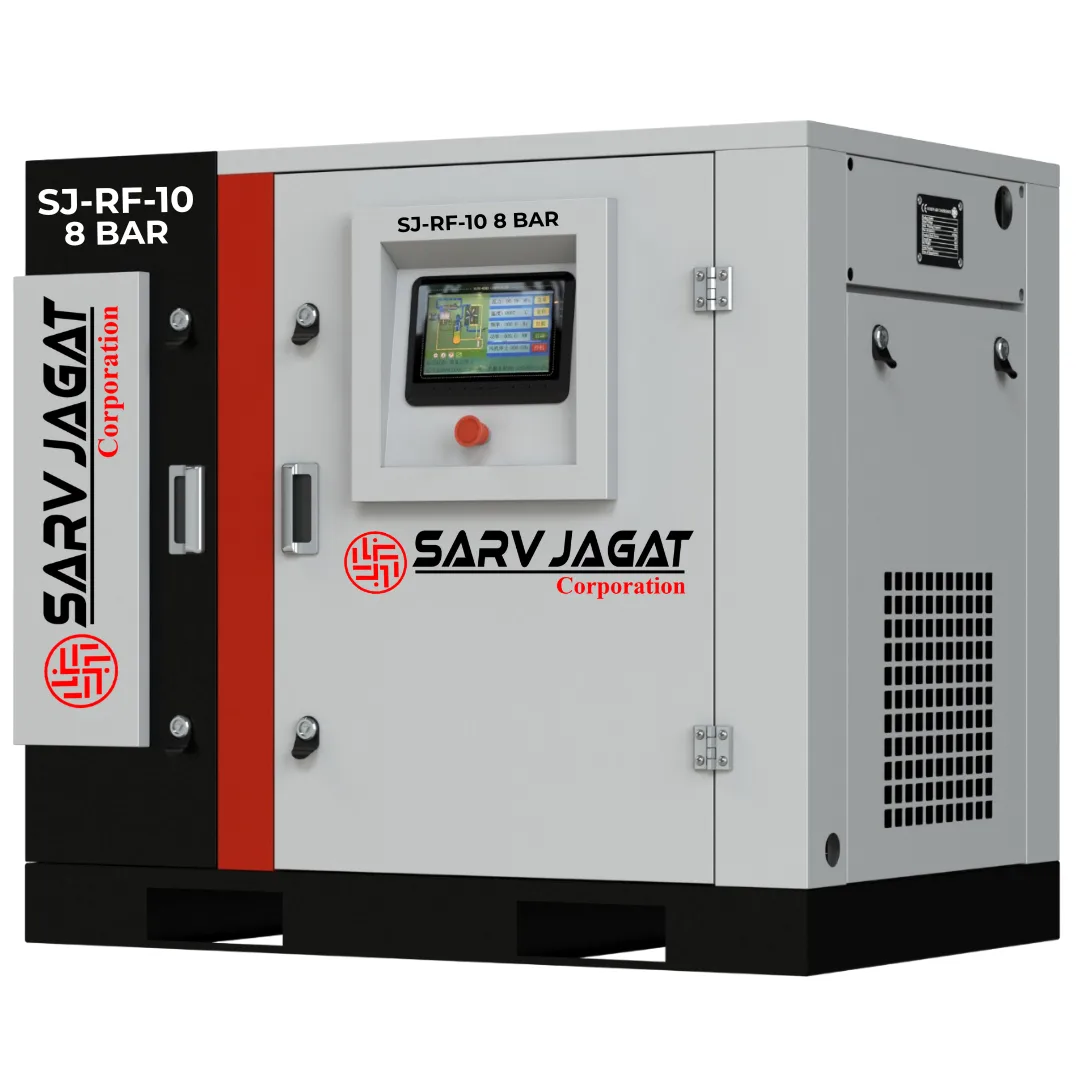
⚙️ Fixed Speed Drive
10 HP 8 Bar SJ Fixed Speed Screw Air Compressor
Buy 10 HP 8 Bar Fixed Speed Screw Air Compressor from Sarv Jagat. Delivers 45 CFM with reliable rotary screw technology, energy efficient & Low maintenance.
Power10 HP7.5 kW
Pressure8 Bar116 PSI
Air Delivery45 CFM1.27 m³/m
SJ RF 20Fixed
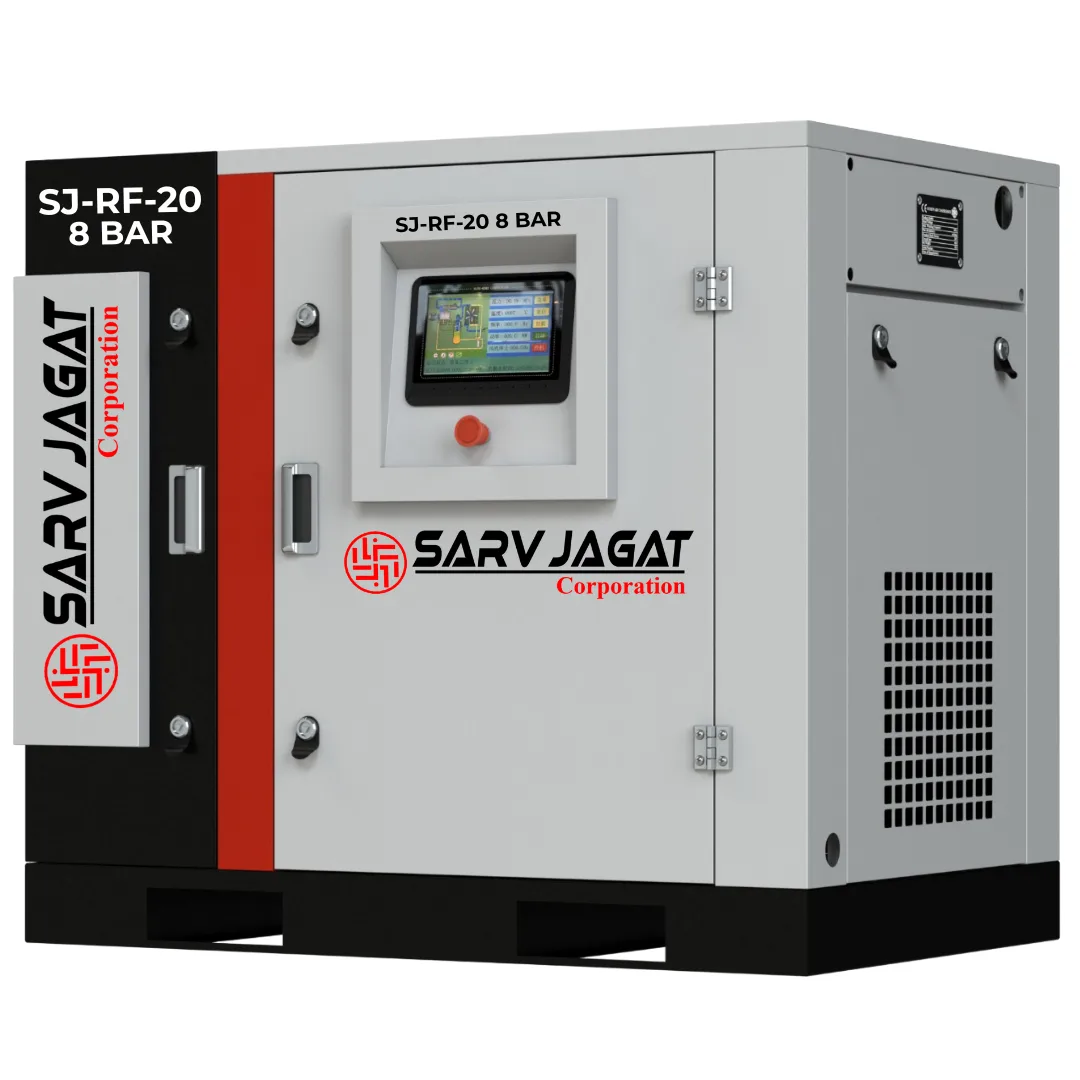
⚙️ Fixed Speed Drive
20 HP 8 Bar SJ Fixed Speed Screw Air Compressor
Buy SJ RF20 20 HP 8 Bar Fixed Speed Screw Air Compressor. 85 CFM (2.41 m³/min), oil injected rotary screw technology for industrial use.
Power20 HP15 kW
Pressure8 Bar115 PSI
Air Delivery85 CFM2.41 m³/m